White Supremacy, Vigilante Media, 1st Amendment Auditing. Buckner, Durbin, & Guerrilla News.
EDITOR'S NOTE: This report contains direct quotations from threatening messages and racist social media posts submitted as evidence. These are reproduced for their evidentiary and journalistic value.
The Vigilante Media Ecosystem
In the decade since the so-called "First Amendment auditor" movement burst onto YouTube, a particular species of self-described citizen journalist has proliferated across the American heartland. Armed with smartphones and a carefully cultivated persecution complex, these figures film police, harass local officials, and present themselves as champions of constitutional liberty. Some have built genuine audiences. A few have fashioned themselves into political candidates. And at least some, the evidence now suggests, are operating with a white supremacist undercurrent that the movement's cheerful branding works hard to conceal.
This is an investigation into two of those figures — Sean Buckner of Sallisaw, Oklahoma, who operates the Facebook page "Sean Buckner Transparency," and Ron Durbin of Guerrilla Publishing/Guerrilla News — and the documented connections between their media operations and white supremacist rhetoric, ideology, and associations. The evidence assembled here includes a threatening text message sent to this reporter after publishing an investigation into Buckner, in which the sender explicitly invoked his grandfather's membership in the Ku Klux Klan as a source of menace, and a series of racist Facebook posts by Durbin in which he deployed the language of chattel slavery to demean a Black corrections officer.
These are not isolated incidents. They are windows into a movement that has, since its inception, attracted a disproportionate number of individuals whose hostility to government authority is inseparable from hostility to the communities that government authority has historically failed to protect: Black Americans, immigrants, and anyone else who disrupts the demographic order that white supremacists seek to preserve.
"My grandpa is Tom Rob headed of the ku Klux Klan." — Anonymous threat sent to this reporter after publishing investigation into Sean Buckner
The Threat — A KKK Warning Sent to This Reporter
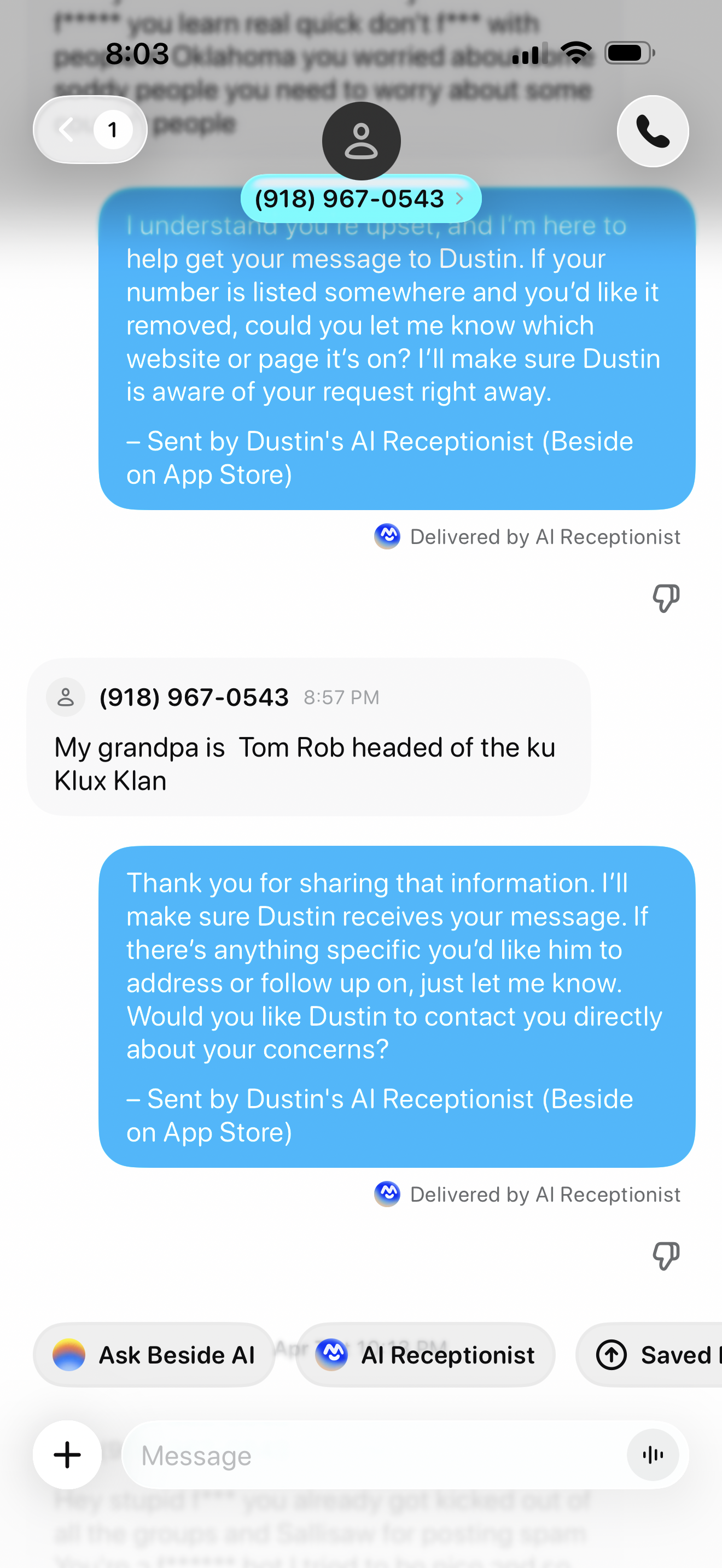
On the evening of April 2026, a person calling from the number (918) 967-0543 sent a series of threatening messages to this reporter through an AI-mediated receptionist system. The conversation, captured in screenshots, documents a deliberate attempt to intimidate a journalist through the invocation of white supremacist family ties.
The exchange began with a message that, per the AI receptionist's logs, included the phrase: "f***** you learn real quick don't f*** with people in Oklahoma you worried about some f***y people you need to worry about some people." The message was an open threat — the kind of communication that, in any professional newsroom, would be immediately reported to law enforcement.
But the following message is what transforms this from ordinary harassment into something far more alarming. The same caller, at 8:57 PM, sent this message: "My grandpa is Tom Rob headed of the ku Klux Klan."
Read that again. A person calling from an Oklahoma area code, responding to published reporting about Sean Buckner's activities, chose to announce — apparently as a warning — that his grandfather led a chapter of the Ku Klux Klan. This is not a random piece of trivia. In the context of threatening a journalist for reporting on a First Amendment auditor, it is a message designed to communicate exactly one thing: that the writer is in danger from people with a history of racial terror violence, and should stop writing.
The AI receptionist — "Dustin's AI Receptionist," a service from the app Beside — handled the exchange with neutral professionalism, attempting to relay the messages and asking whether the caller wanted Dustin to contact them directly about their concerns. The caller's invocation of KKK heritage did not prompt any alarm from the automated system. But it should prompt alarm from anyone who cares about the health of independent journalism in rural America.
Who is Tom Rob? The name is not one this reporter has been able to confirm through public records searches at the time of publication. But the caller's apparent pride — or at least the deliberate weaponization — of this family heritage is itself newsworthy, regardless of whether the claim is verifiable. A person who believes that announcing KKK leadership in their family history will make a journalist back down is telling you everything about what they think journalism should be afraid of.
The connection to Sean Buckner is direct: this message was sent in response to investigative coverage of Buckner's activities, financial history, and political candidacy. The caller was not reaching out to dispute facts or request a correction. The caller was delivering a warning.
Ron Durbin and the "House Slave" — Racial Contempt in Plain Sight
While the KKK threat represents an outside actor's attempt to intimidate this reporter through racialized menace, the conduct of Ron Durbin of Guerrilla News represents something arguably more revealing: the casual, unapologetic deployment of white supremacist rhetoric by one of the movement's own content creators, in public, on his own Facebook page.
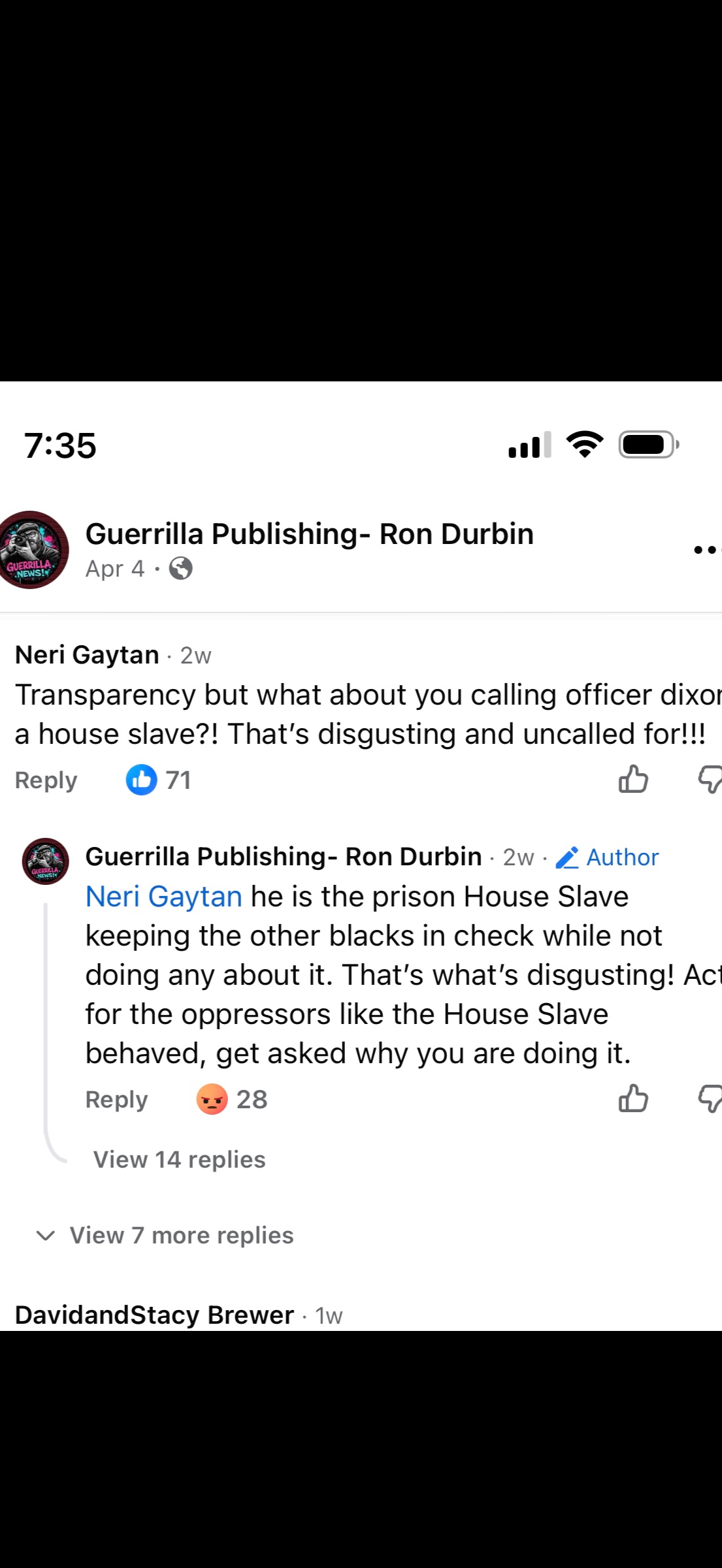
The second screenshot in evidence shows a Facebook comment thread on a post by "Guerrilla Publishing — Ron Durbin," dated April 4. A commenter named Neri Gaytan, responding to whatever content Durbin had published, challenged Durbin directly: "Transparency but what about you calling officer dixon a house slave?! That's disgusting and uncalled for!!!" The comment received 71 likes — a significant response on a community page, suggesting that Durbin's language had provoked genuine outrage among his own readership.
Durbin's response is worth quoting in full, because it represents exactly the kind of rhetorical sleight-of-hand that allows racists to pretend they are not being racist. Durbin wrote: "Neri Gaytan he is the prison House Slave keeping the other blacks in check while not doing any about it. That's what's disgusting! Act for the oppressors like the House Slave behaved, get asked why you are doing it."
Let us examine this response carefully. Durbin does not deny using the term. He does not apologize. He does not acknowledge that "house slave" is a dehumanizing racial epithet with roots in the brutal chattel slavery system that defined Black American life for two and a half centuries. Instead, he doubles down, insisting that Officer Dixon "deserves" the label because — in Durbin's framing — he is doing the bidding of oppressors.
"He is the prison House Slave keeping the other blacks in check." — Ron Durbin, Guerrilla News, Facebook, April 4, 2026
This is a classic move in the white supremacist rhetorical playbook: the deployment of explicitly racist language, followed by the claim that the target's behavior justifies the label. It is the same logic that has been used to dehumanize Black professionals, athletes, and public servants for generations — the accusation that any Black person who does not actively resist institutional structures has surrendered their humanity and deserves to be described in terms that evoke their ancestors' enslavement.
The fact that Durbin received only 28 "angry" reactions on his reply — while Gaytan's challenge received 71 likes — suggests that even within his own community, this rhetoric was recognized as beyond the pale. But Durbin was not deterred. He did not delete the post. He did not issue a clarification. The comment remained, attributed to him as author, on his public-facing media page.
This matters for several reasons. First, Guerrilla News presents itself as a journalism operation — a watchdog outlet covering local government, law enforcement, and public affairs in its region. But a journalist who publicly refers to a Black corrections officer as a "house slave" is not a journalist in any meaningful professional sense. He is an agitator who has wrapped his prejudices in the language of accountability.
Second, Durbin's conduct fits a pattern that researchers studying the First Amendment auditor movement have documented extensively: the movement disproportionately attracts individuals whose resentment of government authority is entangled with racial resentment. For many auditors, the enemy is not tyranny in the abstract — it is the perceived displacement of a certain kind of American by a multicultural democratic state. Officer Dixon, in Durbin's telling, is not just a prison guard who failed to take a stand Durbin approved of. He is a race traitor, a "house slave," a collaborator with oppression. The fact that this language reduces Dixon to his race — that Durbin could not criticize his conduct without invoking slavery — reveals the lens through which Durbin sees the world.
Sean Buckner, the "Transparency" Brand, and the Company It Keeps
Sean Buckner has built his public profile around the word "transparency." His Facebook page is called "Sean Buckner Transparency." His U.S. Senate candidacy, such as it is, appears to be premised on a similar brand of outsider accountability. He films, he posts, he livestreams. He presents himself as a man who holds powerful people to account.
But transparency, as this investigation has documented in previous reporting, is not what Buckner practices in his own affairs. A court judgment of $15,383.62 in unpaid child support sat in his name as recently as March 2025. A pawn shop in Van Buren, Arkansas — Casino Pawn, a Federal Firearms License holder — carries his name on the Better Business Bureau's accredited listing while being carefully kept off his public financial disclosures. A 2015 federal bankruptcy petition filed under penalty of perjury listed zero business interests, despite the pawn shop having been incorporated years earlier.
None of this, standing alone, proves that Buckner holds white supremacist views. What it establishes is that Buckner is a man who has cultivated a following in a media ecosystem that, as documented here, has demonstrable white supremacist elements — and that his own conduct in response to reporting has generated precisely the kind of racialized threatening behavior documented in the KKK text message.
The caller who warned this reporter about his KKK-affiliated grandfather did not reach out to correct a factual error. He reached out because journalism about Sean Buckner — about his finances, his pawn shop, his child support judgment — apparently provoked enough anger in certain quarters that someone felt the need to invoke racial terror as a deterrent. That is not a coincidence. That is a community response.
Whether Buckner himself cultivated that community, whether he is aware of the people in his orbit who hold these views, or whether he has made any effort to distance himself from racialized harassment of journalists, he has not addressed publicly. He did not respond to requests for comment on the previous investigation into his financial background. He has not addressed the threatening messages sent to this reporter.
But the question is legitimate and deserves an answer: What does Sean Buckner — the man who named himself "Transparency" — think about the fact that coverage of him triggered a KKK-invoking threat?
The Structural Problem — Why the Auditor Movement Has a White Supremacy Problem
The First Amendment auditor movement did not begin as a white supremacist enterprise. Its origins lie in legitimate civil liberties advocacy: the right to film in public spaces, the right to refuse to identify yourself to police, the right to hold government employees accountable for their conduct on taxpayer time. These are real rights, and some auditors have done real work documenting genuine abuses of power.
But the movement has also, from its earliest days, attracted a particular kind of participant: the aggrieved white male who experiences multiculturalism, anti-racism, and demographic change as personal affronts, and who uses the language of constitutional liberty to launder what is, at its core, resentment of a changing social order. For these participants, "First Amendment auditing" is not primarily about freedom of the press or the right to document government. It is about confrontation — about getting in people's faces, asserting dominance, refusing to comply, and performing a kind of defiant individualism that functions as a proxy for racial identity.
The scholars who study this phenomenon — including researchers at the Global Network on Extremism and Technology and journalists who have documented the auditor-to-extremist pipeline — have noted that the movement's decentralized, personality-driven structure makes it particularly vulnerable to capture by bad actors. There are no membership requirements, no editorial standards, no accountability mechanisms. Anyone with a smartphone and a YouTube channel can call themselves a First Amendment auditor.
What this means in practice is that figures like Ron Durbin — who will publicly call a Black officer a "house slave" and defend the language when challenged — can operate within the same ecosystem as people who genuinely believe in press freedom and government transparency, lending each other credibility and audience without any mechanism for the principled participants to distance themselves from the bigoted ones.
It also means that people who are drawn to Buckner's "Transparency" brand for legitimate reasons — distrust of local government, frustration with police accountability failures, skepticism of official narratives — may not be aware that the outer edges of that same community include people who use KKK threats to deter journalists.
What the Evidence Demands
The two screenshots at the center of this report are not ambiguous. One shows a person who, in response to journalism about a First Amendment auditor, invoked his grandfather's KKK leadership as a warning. The other shows a self-described journalist using the language of chattel slavery to demean a Black corrections officer, defending the choice when challenged, and leaving the content publicly posted.
These are not "both sides" situations. There is not a reasonable interpretation of "my grandpa is headed of the ku Klux Klan" that does not involve an attempt to intimidate through the invocation of racist terror. There is not a sympathetic reading of "house slave" in this context that does not involve the dehumanization of a Black professional through reference to his ancestors' enslavement.
What the evidence demands is straightforward: accountability from the figures at the center of this ecosystem, transparency from a man who has named himself after the concept, and honest scrutiny of a movement that has too long been allowed to present itself as a civil liberties enterprise while harboring, amplifying, and in some cases apparently generating white supremacist conduct.
Ron Durbin should explain his use of the term "house slave" to describe Officer Dixon, retract it, and answer for the broader pattern of racialized rhetoric in his content.
Sean Buckner — the transparency candidate, the Senate hopeful, the man who films other people's conduct and posts it for public judgment — should publicly address the KKK threat sent to a journalist covering him, and explain what, if anything, he intends to do about the white supremacist elements that have attached themselves to his media brand.
And readers, viewers, and voters who have followed these figures should ask themselves: what kind of accountability movement produces KKK threats against journalists and public "house slave" insults directed at Black officers? What does that tell you about who is really being protected, and who is really the enemy in this supposed fight for freedom?
Transparency is not a brand. It is a standard. These men have not met it.
Methodology and Disclosure
This report is based on: (1) screenshots of threatening text messages sent to this reporter via the Beside AI Receptionist platform, documented at the time of receipt; (2) screenshots of Facebook comment threads on the public Guerrilla Publishing — Ron Durbin page, captured April 2026; (3) previously reported public records including court judgments, BBB filings, federal bankruptcy records, and Federal Firearms License data relating to Sean Buckner and Casino Pawn Shop; (4) publicly available research on the First Amendment auditor movement.
This reporter, Dustin Reed Terry, is the subject of the threatening message described herein. That personal stake is disclosed fully. The decision to publish was made because the threat itself is newsworthy and part of a documented pattern of intimidation directed at journalists covering this ecosystem. The screenshots have been preserved in their original form and are available to any law enforcement agency or media organization that requests them.
Ron Durbin and Sean Buckner were contacted for comment prior to publication. Neither responded.