Think Twice Before Being a Source for Buckner or Guerrilla News
When Protection Becomes Exposure: A PublicCrime.com Investigation
The Unwritten Contract Between Source and Publisher
In journalism, the relationship between a confidential source and a publisher is built on a foundation more sacred than most legal contracts: trust. When someone comes forward with sensitive information—risking their reputation, their relationships, or even their safety—they do so with an implicit understanding that their identity will be protected at all costs. This protection isn't just ethical; it's the bedrock upon which investigative journalism stands.
But what happens when that protection evaporates? What happens when the very people who promised confidentiality decide that exposing their sources serves a more immediate purpose than protecting them?
Recent social media posts by Sean Buckner and Ron Durbin of Guerrilla Publishing have raised serious questions about the integrity of source protection in the world of hyperlocal investigative journalism. These posts suggest a pattern that should make anyone considering becoming a source for these publishers think very carefully about the potential consequences.
The Case Studies: Two Sources, Two Betrayals
Sean Buckner's Casual Exposure
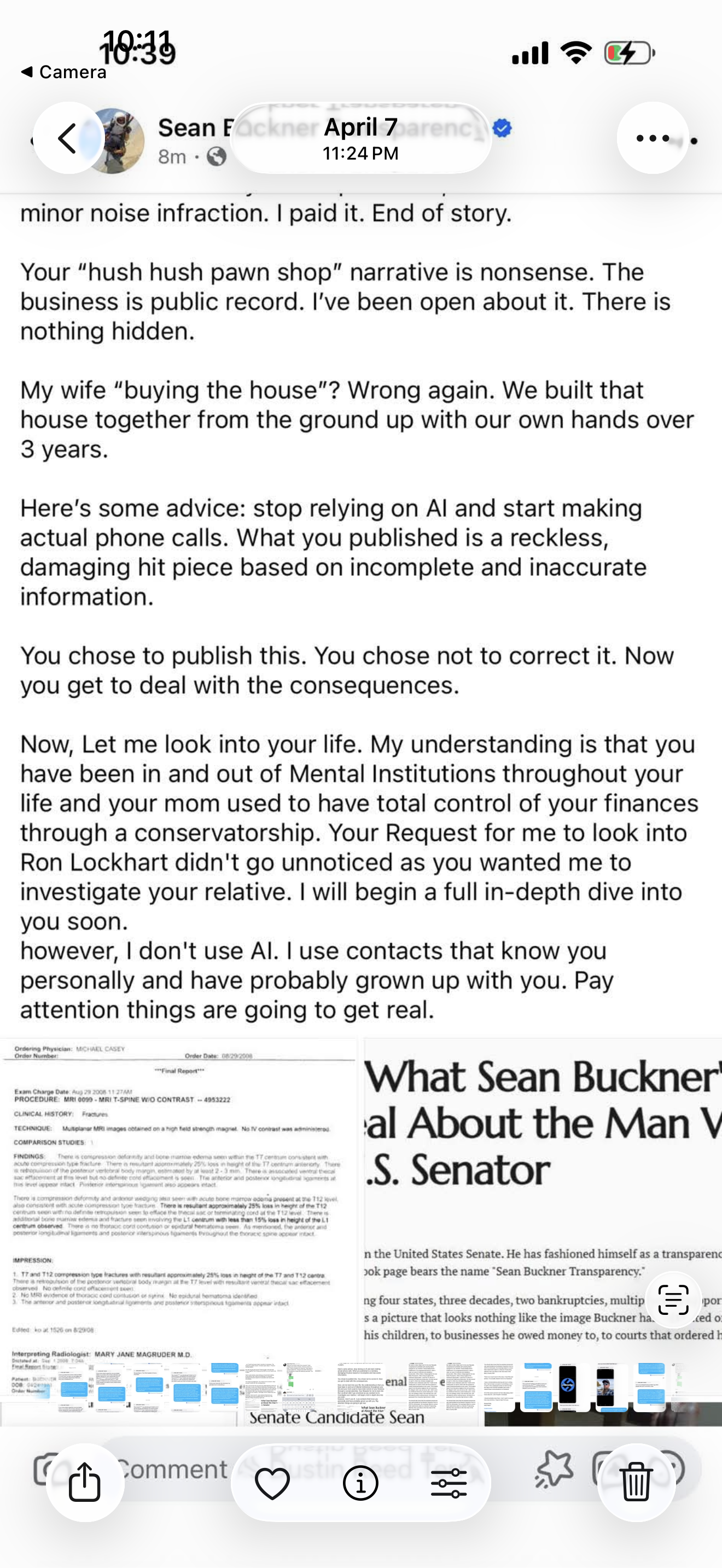
In a Facebook post dated April 7, Sean Buckner found himself responding to criticism about his reporting methods. The post reveals a troubling pattern of behavior that should concern anyone who has ever considered sharing information with Buckner or his affiliated publications.
Buckner's post includes several concerning elements:
The Threat of Investigation: "Now, let me look into your life. My understanding is that you have been in and out of Mental Institutions throughout your life and your mom used to have total control of your finances through a conservatorship."
This isn't journalism—it's intimidation. When a publisher threatens to "look into your life" as retaliation for criticism, they're signaling that information shared with them can and will be weaponized when convenient.
The Casual Name-Drop: "Your Request for me to look into Ron Lockhart didn't go unnoticed as you wanted me to investigate your relative."
Here's where source protection fundamentally breaks down. In his attempt to defend himself, Buckner casually mentions that someone had requested an investigation into "Ron Lockhart." While he doesn't explicitly name his source, the context provided—that Lockhart is the requester's relative—significantly narrows the field of who could have made this request.
This is the journalistic equivalent of a "soft exposure." Buckner is demonstrating that he remembers who asked him to investigate what, and he's willing to reference these requests publicly when it suits his defensive posture. If you've ever asked Buckner to look into something, you should now assume that this request could become public record the moment Buckner feels threatened or criticized.
The Medical Records: Perhaps most disturbing is the attachment of what appears to be medical documentation in Buckner's post. The image shows a medical report with a patient name partially redacted. The weaponization of someone's medical history in a public social media dispute crosses lines that most ethical journalists wouldn't approach, let alone cross.
Ron Durbin's Complete Source Exposure
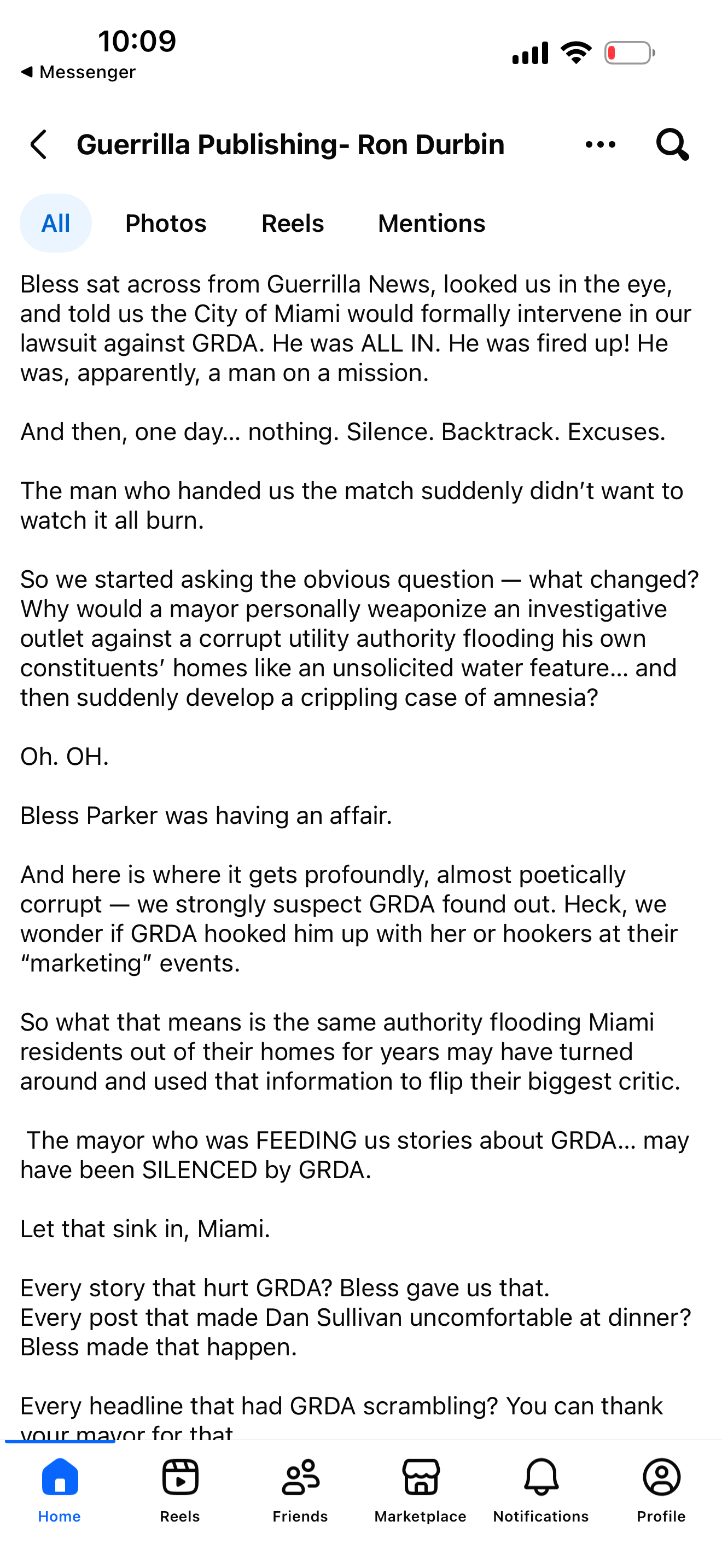
If Buckner's post represented a concerning erosion of source protection, Ron Durbin's posts represent its complete collapse. In a series of Facebook posts from Guerrilla Publishing, Durbin doesn't just hint at his source's identity—he exposes them completely and publicly.
The Setup: Durbin's Guerrilla Publishing account posted what appears to be an extensive exposé about Miami, Oklahoma Mayor Bless Parker and the Grand River Dam Authority (GRDA). The posts make serious allegations about Parker's involvement in leaking information to Guerrilla News and coordinating attacks on GRDA.
The Full Exposure: The key passage that should terrify any current or potential source:
"Who handed us the stories? Who asked us to come to meetings? Who connected us to your dirty laundry? Meet your leak. Mayor Bless Parker of Miami, Oklahoma!
That's right. Every story we ran on GRDA. Every post that made you squirm. Every detail about CEO Dan Sullivan's relationship with Jayme Turner. BLESS PARKER handed it to us. He didn't just tip us off—he recruited us! He called us. He asked us to expose you! He fed us, and boy was it juicy!
He was our source, our contact, and our biggest cheerleader—right up until the moment he wasn't."
This isn't a leak. This isn't an accidental exposure. This is a deliberate, comprehensive, and vindictive outing of a confidential source. Durbin doesn't just name Parker—he details the exact nature of their relationship, the specific stories Parker provided, and the methods of their communication.
The Justification: Durbin's posts attempt to justify this exposure by claiming that Parker backed away from his initial promises:
"Bless sat across from Guerrilla News, looked us in the eye, and told us the City of Miami would formally intervene in our lawsuit against GRDA. He was ALL IN. He was fired up! He was, apparently, a man on a mission.
And then, one day... nothing. Silence. Backtrack. Excuses."
In Durbin's telling, the source protection contract is conditional: if you provide information but then don't follow through with additional support, your confidentiality is forfeit. This creates a dangerous dynamic where sources aren't just providing information—they're entering into an open-ended commitment that, if broken, results in complete exposure.
The Anatomy of Source Betrayal: Understanding the Risks
Risk #1: Conditional Confidentiality
Traditional journalism operates on the principle that source confidentiality is absolute, with narrow exceptions (such as information about imminent harm or crimes against children). Journalists have gone to jail rather than reveal their sources.
What these posts reveal is a different model: confidentiality as a transaction. In this model, your identity remains protected only as long as you continue to be useful or as long as the publisher doesn't feel threatened or criticized.
For anyone considering becoming a source, this raises critical questions:
- What triggers the end of confidentiality? - Is it based on the source's continued cooperation? - Is it based on whether the publisher feels betrayed? - Is it based on whether the publisher comes under criticism? - Is it based on the publisher's assessment of whether the source is acting in bad faith?
None of these questions can be answered with certainty when dealing with publishers who have demonstrated a willingness to expose sources. The risk is that the goalposts can move at any time.
Risk #2: Information Weaponization
Buckner's post about looking into someone's mental health history and conservatorship status reveals another risk: information shared with or discovered by these publishers can be weaponized.
If you approach a publisher with information about corruption in your organization, that same publisher now knows:
- Where you work - What you have access to - What your vulnerabilities are - What motivated you to come forward - Potentially, what you have to lose
This information asymmetry creates leverage. If the relationship sours, the publisher has ammunition that can be deployed against you in ways that have nothing to do with the original story.
Risk #3: Incomplete Anonymization
Even when not naming a source directly, both Buckner and Durbin provide enough context clues that sources could be identified by those in their communities.
Buckner's mention of Ron Lockhart being the critic's relative provides significant identifying information. In small communities, the number of people related to any specific individual is limited.
Durbin's detailed description of Parker's involvement—including specific meetings, promises, and timeline—even before explicitly naming him, would have allowed people familiar with the situation to deduce his identity.
This means that even if a publisher doesn't intend to expose you fully, the details they share about your interactions could be enough for others to figure out who you are.
Risk #4: The Permanent Record
Social media posts are forever. Screenshots circulate. Internet archives preserve. Once your identity as a source is revealed—even partially—that revelation becomes part of your permanent digital record.
Parker's outing as a source will follow him throughout his political career and beyond. Anyone researching him will find these posts. The context may be lost over time, but the fact that he was identified as a source who was later publicly burned will remain.
For potential sources, this means weighing not just the immediate risks of exposure, but the long-term implications of having your role as an informant become part of your permanent public record.
Risk #5: The Chilling Effect on Future Cooperation
Perhaps most significantly, these public source exposures create a chilling effect on future cooperation with these publishers.
If you're a public official, business owner, or community member who has information about wrongdoing, these posts serve as a warning: working with Guerrilla Publishing or associated entities comes with the very real risk that you could be publicly identified if things don't go according to plan.
This doesn't just harm the individuals involved; it harms the broader mission of investigative journalism. Corruption thrives in darkness, and sources are the light. When sources can't trust that they'll be protected, important information stays hidden.
The Ethical Framework: What Source Protection Should Look Like
To understand how far these cases deviate from journalistic norms, it's worth examining what source protection should actually look like:
The Shield Law Principle
Many states have shield laws that protect journalists from being compelled to reveal their sources, even under court order. These laws recognize that confidential sources are essential to the function of a free press and that the public's right to information outweighs the judicial system's desire for complete information in most cases.
The spirit of shield laws is that source protection isn't a favor granted by the journalist—it's a fundamental right of the source that the journalist has an affirmative duty to protect.
The "Taking It to Jail" Standard
Judith Miller, James Risen, and other journalists have faced jail time rather than reveal their sources. This represents the gold standard of source protection: even when facing personal consequences, the journalist prioritizes the source's confidentiality.
While not every journalist may be willing or able to go to jail, the principle is clear: protecting sources is meant to be a higher priority than protecting yourself.
The "No Exceptions" Rule
Reputable news organizations typically operate on the principle that source confidentiality has no exceptions beyond legal requirements (such as imminent harm). The source can release the journalist from the obligation of confidentiality, but the journalist can't unilaterally decide that confidentiality no longer applies.
This means:
- You can't expose a source because they stopped cooperating - You can't expose a source because they turned out to be unreliable - You can't expose a source because you later disagreed with their motives - You can't expose a source because someone criticized you
The commitment is absolute from the moment it's made.
The Transparency Principle
Ethical journalism requires being clear with sources about what protection they can expect. This means:
- Explaining clearly what "off the record" means - Explaining what "confidential source" means - Explaining any circumstances under which their identity might be revealed - Explaining how their information will be attributed - Explaining what records are kept of communications
If a publisher can't or won't provide absolute confidentiality, they have an ethical obligation to tell sources that upfront.
The Community Impact: Beyond Individual Sources
The implications of source exposure extend beyond the individuals directly involved. These cases have broader impacts on the communities these publishers serve.
Undermining Legitimate Accountability Journalism
When publishers burn sources, they make it harder for all journalists—including ethical ones—to do accountability journalism. Sources become more cautious, more skeptical, and more reluctant to come forward.
If you're a resident of Miami, Oklahoma, or the surrounding areas, and you have information about government corruption or wrongdoing, these cases might make you think twice about who you approach. That means important stories might never be told, and accountability might never happen.
Creating Information Vacuums
In smaller communities, there are often limited outlets for investigative journalism. When the available outlets prove untrustworthy, where does that leave community members who witness wrongdoing?
The information vacuum that results can allow corruption to flourish unchecked. Without trusted outlets for whistleblowers, systemic problems may never come to light.
Normalizing Retaliation
Perhaps most concerning is the message these exposures send about retaliation. When publishers model the behavior of publicly attacking and exposing those who criticize them or fail to meet their expectations, it normalizes a culture of retaliation.
This can extend beyond journalism into the broader community. If it's acceptable for publishers to expose and attack their sources, is it acceptable for employers to retaliate against whistleblowers? For public officials to go after their critics? For anyone with power to weaponize information against those who challenge them?
How to Evaluate Source Protection Before You Engage
If you're considering sharing information with a publisher or journalist, here are some questions to ask and red flags to watch for:
Questions to Ask
1. "What exactly does 'confidential' mean in our arrangement?" - Get specific commitments in writing if possible - Understand what scenarios might lead to exposure - Know what records will be kept of your communications
2. "Have you ever revealed a source's identity? Under what circumstances?" - A history of source exposure is the strongest predictor of future exposure - How the publisher talks about past sources tells you how they might talk about you
3. "What happens if we disagree later about how the story is handled?" - Understanding the conflict resolution process can reveal whether confidentiality is conditional - If the answer involves threats or intimidation, walk away
4. "What steps do you take to protect source identity in your reporting?" - Technical measures (encrypted communications, secure document transfers) - Operational security (how notes are kept, who has access to source identities) - Attribution practices (how information is presented without identifying the source)
Red Flags to Watch For
1. Conditional language about confidentiality - "I'll protect you as long as..." - "Your identity is safe unless..." - Any suggestion that protection depends on your continued cooperation
2. History of public feuds and retaliation - Publishers who regularly engage in public disputes with critics - Use of personal information or attacks in these disputes - Pattern of "burning" former allies or associates
3. Lack of formal policies - No written ethics guidelines - No clear standards for source protection - Resistance to putting commitments in writing
4. Pressure tactics - Rushing you to provide information - Suggesting that delaying means missing the opportunity - Making the arrangement seem more casual than it is ("just between us")
5. Mixing personal and professional grievances - Using their platform to settle personal scores - Inability to separate criticism from betrayal - Viewing sources as allies rather than informants
Case Study Analysis: What Went Wrong
The Bless Parker Case: A Timeline of Trust Erosion
Based on Durbin's posts, we can reconstruct what appears to have happened:
Phase 1: Initial Contact and Story Development
- Parker allegedly approached Guerrilla Publishing with information about GRDA - Stories were developed and published based on this information - The relationship appeared mutually beneficial
Phase 2: Escalating Commitment
- Parker allegedly promised that Miami would formally intervene in Guerrilla's lawsuit - Durbin appears to have relied on these promises in his strategy - The relationship evolved from source-journalist to strategic partners
Phase 3: The Breakdown
- Parker allegedly backed away from his promises - Communication allegedly ceased - Durbin felt betrayed by the lack of follow-through
Phase 4: Retaliation
- Durbin made the decision to publicly identify Parker - The exposure was comprehensive and detailed - Justification focused on Parker's alleged betrayal rather than any journalistic necessity
Critical Error Points:
1. Blurring Lines: The relationship appears to have evolved from traditional source-journalist to strategic partnership. This created expectations beyond information sharing.
2. Conditional Protection: The exposure was justified based on Parker's alleged failure to follow through, suggesting protection was conditional on continued cooperation.
3. Personal Investment: Durbin's language ("He was our source, our contact, and our biggest cheerleader") suggests emotional investment that may have clouded professional judgment.
4. Retaliation Over Principle: The exposure appears motivated by feeling betrayed rather than by any journalistic principle or legal requirement.
The Sean Buckner Case: Defensive Exposure
Buckner's situation differs slightly but reveals similar problems:
The Context:
- Buckner was being criticized for his reporting methods - The critic appeared to be someone Buckner had previous interactions with - Buckner's response included both defending his work and attacking his critic
The Exposure:
- While not naming the source of the Ron Lockhart investigation request directly, Buckner provided enough context to narrow the field significantly - The exposure served no journalistic purpose—it was purely defensive
Critical Error Points:
1. Using Source Information Defensively: The mention of the Ron Lockhart request was used to bolster Buckner's defense against criticism, not to serve any reporting purpose.
2. Weaponizing Personal Information: The references to mental health and conservatorship represent a willingness to use sensitive personal information as a weapon.
3. Permanent Record: Even this partial exposure becomes part of the permanent record for anyone associated with the Ron Lockhart name.
The Legal Landscape: When Source Protection Has Legal Teeth
It's worth understanding that in many jurisdictions, source protection isn't just an ethical obligation—it can have legal dimensions.
Shield Laws
Many states have reporter shield laws that protect journalists from being compelled to reveal confidential sources. While these laws primarily protect against legal compulsion rather than voluntary disclosure, they reflect a public policy recognition that source protection serves the public interest.
Voluntary exposure of sources may not violate shield laws, but it certainly violates their spirit and can undermine the policy rationale behind them.
Breach of Confidence
In some circumstances, revealing a source's identity could potentially constitute a breach of confidence or breach of contract, particularly if explicit confidentiality promises were made.
While these cases are rare in journalism contexts, they're not impossible, especially when: - Written confidentiality agreements exist - The source can demonstrate concrete harm from the exposure - The exposure served no public interest
Professional Consequences
For journalists who belong to professional organizations or who work for organizations with ethics codes, source exposure can lead to professional consequences:
- Expulsion from professional organizations - Loss of credibility with other sources - Difficulty getting hired by reputable news organizations - Loss of access to official sources who view them as untrustworthy
Alternatives: How to Share Information More Safely
If you have information about wrongdoing but are concerned about source protection, there are alternatives to approaching publishers with questionable track records:
Established News Organizations
Major news organizations typically have: - Formal ethics policies - Legal teams that take source protection seriously - Institutional incentives to protect sources (their reputation depends on it) - Secure submission systems for confidential information
Government Whistleblower Protections
For information about government wrongdoing: - Federal and state whistleblower protection laws - Inspectors General offices - Government accountability organizations
Legal Channels
Depending on the nature of the information: - Law enforcement (with understanding that you're not a confidential source in that context) - Regulatory agencies - Bar associations for attorney misconduct - Medical boards for medical misconduct
Anonymous Submission Platforms
Several platforms exist for anonymous whistleblowing: - SecureDrop (used by many major news organizations) - WikiLeaks (controversial but provides anonymity) - Industry-specific whistleblower platforms
Document Preservation First
Before approaching any publisher: - Make copies of all relevant documents - Store them securely - Consider having a lawyer hold copies - Understand that once information is shared, you've lost some control over it
The Psychology of Source Exposure: Why Publishers Burn Sources
Understanding why publishers expose sources can help potential sources evaluate risk:
Emotional Investment
When journalists become personally invested in stories or outcomes, they may feel personally betrayed when sources don't deliver what was expected. This emotional response can override professional judgment.
Ego and Defensiveness
Public criticism can trigger defensive reactions. For publishers who see themselves as crusaders or truth-tellers, criticism may feel like an attack on their identity, leading to aggressive responses.
Transactional Relationships
Some publishers view sources transactionally: you provide value, you receive protection. When the value stops flowing, the protection ends. This fundamentally misunderstands the ethical foundation of source protection.
Lack of Institutional Constraints
Independent publishers or small operations may lack the institutional structures that enforce ethical behavior in larger organizations: - No editor to overrule bad judgment - No legal team to warn about consequences - No professional reputation (institutional) to protect - No colleagues to provide accountability
The Audience Factor
In the age of social media, publishers may be performing for their audience as much as practicing journalism. Exposing a source can be dramatic, can generate engagement, and can serve as a demonstration of power.
Moving Forward: Rebuilding Trust
For the communities served by these publishers, and for the publishers themselves if they choose to reform, rebuilding trust requires concrete steps:
For Publishers
1. Acknowledge Past Mistakes - Public acknowledgment of source exposures - Explanation of what went wrong - Commitment to different standards going forward
2. Implement Clear Policies - Written ethics guidelines - Clear standards for source protection - Defined processes for handling confidential information
3. Create Accountability Structures - Editorial review processes - Ombudsman or ethics advisor - Transparent correction policies
4. Separate Personal from Professional - Establish boundaries between personal grievances and professional duties - Avoid using platforms for personal attacks - Maintain professional tone even under criticism
For Communities
1. Demand Standards - Ask publishers about their source protection policies - Hold publishers accountable for violations - Support ethical journalism financially and through engagement
2. Create Alternatives - Support establishment of alternative local news sources - Encourage ethical journalism through community journalism initiatives - Provide resources for investigative reporting done ethically
3. Protect Whistleblowers - Advocate for stronger whistleblower protections - Create community resources for those with information about wrongdoing - Reduce dependence on any single publisher
For Potential Sources
1. Do Your Homework - Research the publisher's track record - Talk to others who have worked with them - Look for patterns of behavior
2. Get Commitments in Writing - Email confirmations of confidentiality agreements - Clear understanding of terms - Documentation of all communications
3. Consider Alternatives - Don't assume there's only one outlet for your information - Explore multiple options before committing - Prioritize organizations with proven track records
4. Protect Yourself - Don't share more than necessary - Keep your own records - Consider legal advice before becoming a source
Trust in an Age of Distrust
These cases of source exposure occur against a broader backdrop of declining trust in journalism and media. According to various polls, public trust in media is at or near all-time lows. Every instance of source betrayal contributes to this erosion of trust.
The Vicious Cycle
1. Publishers burn sources 2. Sources become reluctant to come forward 3. Important stories don't get told 4. Public perceives media as ineffective or biased 5. Trust in journalism declines 6. Publishers struggle financially and professionally 7. Corners get cut, standards slip 8. Return to step 1
Breaking the Cycle
Breaking this cycle requires commitment from all stakeholders:
- Publishers must prioritize ethics over engagement, long-term credibility over short-term victory - Communities must support quality journalism while demanding accountability - Sources must make informed decisions about when and how to share information - Platforms (social media companies) must consider their role in amplifying harmful disclosur
The Cost of Broken Trust
The cases of source exposure by Sean Buckner and Ron Durbin serve as cautionary tales for anyone considering sharing confidential information with publishers. They demonstrate that source protection, which should be absolute, can become conditional, weaponized, or completely abandoned when relationships sour or when publishers feel threatened.
For potential sources, the message is clear: think twice, do your homework, and understand the risks. The information you share might be important, but your personal and professional wellbeing is important too. Make sure the publisher you choose to trust has earned that trust through demonstrated commitment to source protection, not just convenient promises.
For communities that depend on investigative journalism to hold the powerful accountable, these cases should prompt serious questions about the accountability journalism ecosystem. How can communities support ethical journalism while holding publishers to high standards? How can we ensure that those with information about wrongdoing have safe, trustworthy channels for disclosure?
And for the publishers themselves, these cases present an opportunity for reflection and reform. Is the short-term satisfaction of exposing someone who disappointed you worth the long-term cost to your credibility? Is winning a social media argument worth permanently damaging your ability to develop confidential sources in the future?
The answers to these questions will determine not just the future of Guerrilla Publishing and associated entities, but the future of accountability journalism in the communities they serve.
The lesson is simple but critical: confidential means confidential. If it doesn't, the entire system of investigative journalism breaks down.
Before you become a source, make sure the person you're trusting understands this principle and has demonstrated—through actions, not just words—a commitment to upholding it. Your reputation, your relationships, and your community depend on it.
Questions That Remain
As this article goes to publication, several questions remain:
1. Will Mayor Bless Parker face political consequences from Durbin's exposure of his role as a source?
2. Will other potential sources in Miami, Oklahoma, and surrounding areas be more or less likely to come forward with information about government wrongdoing?
3. Will Guerrilla Publishing implement any changes to their source protection policies?
4. Will Sean Buckner address the concerns raised about his handling of source information?
5. What legal recourse, if any, might be available to sources who feel they were improperly exposed?
These questions underscore the ongoing nature of this issue. Source protection isn't a one-time decision—it's an ongoing commitment that shapes the practice of journalism and the health of democratic accountability.
The communities served by these publishers deserve better. Sources who risk their reputations to expose wrongdoing deserve better. And journalism as a profession deserves better.
Whether things improve depends on the choices made by publishers, sources, and communities in the days and years ahead. This article serves as both a warning and a call to action: the status quo is unacceptable, and change is necessary.
The question is whether that change will come from within, through reform and renewed commitment to ethical journalism, or from without, through community demand for alternatives and accountability.
Time will tell.
PublicCrime.com is committed to ethical journalism and absolute source protection. If you have information about wrongdoing in your community, please review our source protection policies before reaching out. We never reveal confidential sources under any circumstances.
This article was produced based on publicly available social media posts and does not rely on confidential sources. All individuals named in this article made their statements publicly on social media platforms.