Sean Buckner Believed His Traffic Stop Was Racial Discrimination. A DEI Traffic Stop.
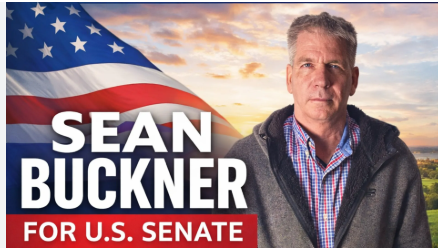
Sean Buckner, U.S. Senate Candidate
The Race Card on Highway 64 — The Civil Rights Claim a Federal Judge Flatly Rejected
William Sean Buckner — Air Force veteran, real estate broker, and now U.S. Senate candidate — filed a federal racial discrimination lawsuit after a traffic stop. He said asking about his Cherokee citizenship was bigotry. A federal judge said the law, and the facts, told a different story entirely.
The following analysis is drawn from the full Opinion and Order issued by United States Magistrate Judge Jason A. Robertson in the Eastern District of Oklahoma on March 31, 2023, in the matter of Buckner v. City of Sallisaw et al. The document was obtained and independently reviewed by this outlet.
Case Number CIV-22-146-JAR (E.D. Okla.)
Filed By Plaintiff William Sean Buckner, Sallisaw, OK
Defendants City of Sallisaw; Lt. Houston Murray; Chief Terry Franklin
Ruling Date March 31, 2023
Racial Claim Statute 42 U.S.C. § 1981
Outcome on Race Claim DISMISSED — No constitutional violation found
It was dusk on October 23, 2021, on Highway 64 in Sallisaw, Oklahoma — the gateway to Sequoyah County, deep in the heart of what the United States Supreme Court had ruled just one year earlier was still, legally speaking, Cherokee Nation territory. William Sean Buckner and his wife were driving. A Sallisaw police cruiser spotted them, turned around, activated its lights, and pulled them over. What happened in the next few minutes on that motel parking lot would eventually find its way to federal court — and the legal claim at the center of it would be dismissed as fundamentally misreading both the Constitution and the history of Oklahoma itself.
The reason Buckner gave for calling the traffic stop racially motivated? A police lieutenant asked him if he was Native American.
In May 2022, Buckner filed a federal civil rights lawsuit in the U.S. District Court for the Eastern District of Oklahoma, naming the City of Sallisaw, Lieutenant Houston Murray — the officer who conducted the stop — and Police Chief Terry Franklin as defendants. Among three causes of action, Buckner included a claim under 42 U.S.C. § 1981, the federal statute guaranteeing equal rights under the law, alleging he had been subjected to racial discrimination because of his Cherokee Nation citizenship and his Cherokee-issued vehicle tag.
On March 31, 2023, United States Magistrate Judge Jason A. Robertson issued his ruling. The racial discrimination claim was dismissed. Not reduced. Not narrowed. Dismissed — entirely and without equivocation — for two independent reasons, either of which alone would have been fatal to the claim.
The opinion, obtained and reviewed in full by this outlet, is a methodical dismantling of Buckner's racial discrimination theory. It is also, read against the backdrop of the 2020 Supreme Court ruling in McGirt v. Oklahoma, a vivid illustration of what happens when a grievance is dressed up as constitutional law — and a federal judge declines to play along.
What Buckner Alleged
According to his own Verified Complaint, Buckner's account of the October 23 encounter was as follows: Lt. Murray pulled him over, citing a burned-out headlamp. Buckner exited his vehicle to check the lights. His wife switched from high beam to low beam and both headlights appeared to be working. Buckner told Murray the issue was resolved. Murray, Buckner alleged, said he didn't care — and that his patrol camera would prove otherwise.
From there, the encounter escalated. Buckner says he returned to his vehicle and asked whether he was getting a citation. Murray said he had initially intended to give a warning, but because of Buckner's attitude, he was now writing a ticket. When Murray presented the citation, a nearby vehicle made a loud noise. Murray asked: "Are you going to sign this citation?" Buckner answered "No" — intending, he said, to say "No, before I read it" — but claims Murray didn't wait for him to finish the sentence.
Murray backed away from the window, placed his hand on his gun, and ordered Buckner out of the vehicle. He was placed under arrest. Buckner alleged the handcuffs were applied so tightly they peeled skin from his wrists — and that Murray used that flinching as a pretext to add a resisting arrest charge. His vehicle was impounded despite his wife being present and available to drive it home, leaving her to find her own way back four miles.
After his arrest, Buckner alleged he never received a traffic citation or notice to appear in any court — suggesting, in his view, that the stop itself had no legitimate basis.
The Three Claims
Claim 1 — § 1981 Racial Discrimination Alleged disparate treatment as a Cherokee Nation citizen. Dismissed entirely.
Claim 2 — § 1983 Civil Rights (Excessive Force / False Arrest) Survived dismissal in part; excessive force claim allowed to proceed to discovery.
Claim 3 — Failure to Train / Supervise Survived dismissal against the City; allowed to proceed.
These are grievances a court was willing to allow to proceed to discovery and possible summary judgment. A wrongful arrest, excessive force, failure to train: these are the kinds of claims federal courts take seriously, and Judge Robertson allowed them to survive the initial dismissal motions.
But Buckner went further. He claimed the entire stop — the question Murray asked about his tribal citizenship, the Cherokee-issued license plates on his vehicle — amounted to racial discrimination under federal civil rights law. That claim, the court found, rested on a fundamental misunderstanding of both the statute and the legal landscape of post-McGirt Oklahoma.
Racial Discrimination and What the Law Actually Says
The statute Buckner invoked, 42 U.S.C. § 1981, is one of the oldest civil rights laws on the books — a Reconstruction-era provision guaranteeing that all persons within U.S. jurisdiction have the same right to make and enforce contracts, to sue, to give evidence, and to enjoy the equal benefit of all laws, as white citizens. It is a powerful tool against racial discrimination in contracting and certain commercial contexts.
But it is not a general-purpose civil rights statute covering every interaction with law enforcement. And Judge Robertson's opinion was blunt on this point.
"Plaintiff's § 1981 claim suffers from two deficiencies on the face of the Complaint — (1) the traffic stop involved in this case does not entail the type of protected activity set out in § 1981; and (2) no intentional racial discrimination has been stated in the Complaint."
"A review of the allegations as made by Plaintiff does not involve the making or enforcement of contracts or any of the other activities provided by § 1981. As a result, the claim cannot be maintained."
In plain terms: a traffic stop is not a contract. It is not a commercial transaction. It is not one of the specific categories of activity § 1981 was enacted to protect. Buckner's invocation of the statute to cover a roadside encounter with a police officer was, in the court's analysis, simply the wrong legal tool for the job — regardless of what happened during the stop.
That alone was enough to dismiss the racial discrimination claim. But the court didn't stop there.
The Question That Wasn't Racism: McGirt and the Law of the Land
The heart of Buckner's racial discrimination argument was this: when Lt. Murray asked whether he was Native American during the traffic stop, that question was "highly offensive" and evidence of discriminatory intent. Buckner felt singled out because of his Cherokee citizenship. He felt the question, combined with the officer checking his Cherokee-issued license plates, showed the stop was racially motivated.
Judge Robertson acknowledged that Buckner found the question offensive. Then he explained, in careful legal and historical detail, why the question was not only permissible — it was legally necessary.
"The Supreme Court's decision in McGirt v. Oklahoma, 207 L. Ed. 2d 985, 140 S. Ct. 2452 (2020) determined that the reservations of the Muscogee (Creek) Nation had not been disestablished and that the state courts had no jurisdiction over the Muscogee Nation's citizens on reservation land to prosecute crimes under the Major Crimes Act."
"Since the McGirt decision and its progeny, this Court takes judicial notice from its own dockets it has become necessary for law enforcement to ascertain if the suspect that they are detaining are citizens of Native American nations in order to determine whether the appropriate venue for prosecution is state, federal, or tribal courts."
"The various Indian Nations in Oklahoma do not issue their own driver's licenses as other states within the United States. Therefore, the Native American citizenship of a particular individual is not readily ascertainable in a traffic stop, for instance, without questioning. No racially discriminatory intent can reasonably be derived from the mere question of tribal citizenship. Plaintiff may have considered the remark offensive, but it was not constitutionally violative."
This is the ruling's most historically significant passage — and the one that most directly undercuts Buckner's narrative. To understand why, one must understand what McGirt v. Oklahoma actually changed.
The World McGirt Made
On July 9, 2020, the United States Supreme Court handed down one of the most consequential decisions in Oklahoma's history. In a 5-4 ruling written by Justice Neil Gorsuch, the Court held that the domain reserved for the Muscogee Nation by Congress in the 19th century has never been disestablished and constitutes Indian country for the purposes of the Major Crimes Act, meaning that the state of Oklahoma has no right to prosecute American Indians for crimes allegedly committed therein.
The Oklahoma Court of Criminal Appeals subsequently applied the same logic to nine additional tribal nations. The result was seismic: almost the entirety of the eastern half of what is now the state of Oklahoma remains Indian country, meaning that criminal prosecutions of Native Americans for offenses therein falls outside the jurisdiction of Oklahoma's court system.
Sallisaw — where Buckner was pulled over — sits in Sequoyah County, which lies within the historic boundaries of the Cherokee Nation's reservation. That reservation, like the Muscogee Nation's, was found by the Oklahoma Court of Criminal Appeals to have never been disestablished. The traffic stop on Highway 64 did not occur in legal ambiguity — it occurred in territory where the question of a driver's tribal citizenship had direct, immediate, practical consequences for which court would handle any resulting charges.
After McGirt, as Judge Robertson noted from his own court's dockets, some police officers may ask if a driver is a citizen of a tribe, and some may not — and tribal citizens who commit offenses may receive a court date at a municipal court or at the Cherokee Nation District Court, depending on the ticketing agency's agreement with the tribe.
"Plaintiff may have considered the remark offensive, but it was not constitutionally violative."
— U.S. Magistrate Judge Jason A. Robertson, Opinion and Order, March 31, 2023
The Cherokee Nation itself, in published guidance on the McGirt ruling, has noted that officers asking about tribal citizenship is part of the post-McGirt landscape: it is important to cooperate with law enforcement any time you are stopped by police, and some police officers may ask if you are a citizen of a tribe. The Nation has encouraged tribal citizens to inform officers of that fact — not as a challenge to authority, but because it determines jurisdiction.
Murray's question, in other words, was not the mark of a bigot. It was the mark of an officer doing his job in the legal world that the Supreme Court created in 2020. Buckner's attempt to reframe that question as racial animus did not survive contact with the actual law.
What the Cherokee Tags Actually Meant — And Didn't Mean
Buckner also alleged that Murray running his Cherokee Nation license plates through the police computer — and confirming the vehicle was registered to Buckner with Cherokee tags — was further evidence of racial targeting. The court did not address this specific allegation separately from the broader § 1981 analysis, but the legal context makes the argument untenable on its face.
Running a license plate is a routine and universal component of any traffic stop. That the plates in question were issued by the Cherokee Nation, rather than the State of Oklahoma, provided Murray with information directly relevant to the jurisdictional question McGirt had placed at the center of every law enforcement encounter in eastern Oklahoma. A Cherokee-issued tag on a vehicle in Sequoyah County was not a red flag of racial animus — it was a data point with direct legal significance.
Any of the 90 law enforcement agencies that are cross-deputized with the Cherokee Nation can pull over a tribal citizen, issue a ticket, or make an arrest. But determining which court handles the resulting charges — state, federal, or tribal — required knowing whether the driver was a tribal citizen. Running Cherokee plates and asking about citizenship were two sides of the same jurisdictional coin.
The Claims That Did Survive
It would be a misreading of the court's opinion — and a disservice to Buckner's account — to suggest that Judge Robertson found no merit whatsoever in his lawsuit. He did not.
Two of Buckner's three claims survived the motion to dismiss stage. The court declined to rule out, at the pleading stage, that Murray's use of force during the arrest — the tight handcuffing, the alleged skin-peeling, the "stop resisting" response to a flinch — might have constituted excessive force. On that claim, the court denied qualified immunity and allowed discovery to proceed. The failure-to-train claim against the City was also allowed to move forward, the court finding the allegations sufficient, if thin, to meet the federal pleading standard.
These were real legal opportunities. Buckner, through his legal team, could have pursued them through discovery — deposing Murray, obtaining the patrol camera footage, building an evidentiary record. The excessive force claim, if the facts bore out his account, had the potential to result in a settlement or judgment in his favor.
He did not pursue that path. Instead, Buckner appealed the dismissal of the racial discrimination claim to the Tenth Circuit — engaging an attorney, James A. Conrady, who turned out to have been suspended from practicing in that court thirteen years earlier. When this was discovered, Conrady was removed as counsel. Buckner ultimately moved to voluntarily dismiss the entire case in August 2025 — abandoning not just the race claim that had already been thrown out, but the excessive force and failure-to-train claims that had survived.
The case was dismissed with prejudice. The $50,000 in attorneys' fees the court had ordered Buckner to pay stood.
The Politics of the Claim
William Sean Buckner is now running for the United States Senate seat vacated by Markwayne Mullin, in a Republican primary where he faces the Trump-endorsed Kevin Hern and a crowded field. His campaign pitch, to the extent it has a coherent ideological shape, appears rooted in the brand of anti-establishment grievance that has animated his public activities in Sallisaw — the lawsuit, the alliance with disbarred provocateur Ron Durbin, the campaigns to "indict" local officials.
The racial discrimination claim fits that brand neatly. A Cherokee Nation citizen, pulled over in Indian Country, claiming the system was rigged against him. It is a compelling story — until a federal judge explains, in 13 pages of careful legal analysis, why the story doesn't hold up.
The irony is layered. Buckner invoked his Cherokee citizenship as the basis for a discrimination claim — then pursued it through a statute that doesn't cover traffic stops, against a backdrop of Supreme Court law that specifically legitimized the question he found offensive, in a case he ultimately walked away from before the surviving claims could be tested.
Had Buckner genuinely suffered excessive force at the hands of Murray — had the handcuff injuries been as he described, had the arrest been as pretextual as he alleged — the law gave him a vehicle to pursue that claim. He chose instead to anchor his legal identity to the race discrimination theory. A federal judge found that theory legally groundless. And a Senate candidate who built part of his public narrative on that grievance now asks Oklahoma voters to trust his judgment on matters of federal law.
The McGirt Context: A State Still Figuring It Out
It would be unfair to Buckner — and incomplete as journalism — to dismiss the underlying tensions his lawsuit touched, even as the legal theory failed. Post-McGirt Oklahoma is genuinely complicated territory, and not every municipality or law enforcement agency has navigated it cleanly.
After the McGirt ruling, cities are supposed to turn over traffic citations for Indigenous people to tribal courts — but some Oklahoma towns have continued to give tribal citizens traffic citations in defiance of the ruling. The Muscogee Nation has sued at least one municipality, Henryetta, for precisely this kind of non-compliance. The post-McGirt enforcement landscape remains, five years on, a patchwork.
And Buckner's underlying complaint — that he was arrested, handcuffed tightly enough to injure him, and had his vehicle impounded over what amounted to a headlight dispute — is not inherently implausible as a story of police overreach. Those claims deserved their day in court.
But Buckner did not give them that day. He attached his case to a racial discrimination theory that collapsed on first contact with the law, surrounded himself with disbarred attorneys to pursue an unwinnable appeal, and ultimately withdrew from the field — leaving the $50,000 judgment standing and his remaining legitimate claims abandoned.
That is not the story of a man wronged by the system. It is the story of a man who mistook grievance for law — and is now asking the people of Oklahoma to send him to Washington to make more of it.
Editor's Note on SourcesThe Opinion and Order of U.S. Magistrate Judge Jason A. Robertson, dated March 31, 2023, in Buckner v. City of Sallisaw et al., Case No. CIV-22-146-JAR (E.D. Okla.), was obtained and reviewed in full by this outlet. All quotations from the court document are drawn directly from that record. Background on the McGirt v. Oklahoma ruling was drawn from the Supreme Court opinion, the Oklahoma Court of Criminal Appeals, the Cherokee Nation's published FAQ on the ruling, and reporting by The Frontier and KOSU. Buckner was contacted for comment prior to publication. No response was received.
