Comprehensive Investigative Report on Senate Candidate Sean Buckner
EDITOR'S NOTE — UPDATE TO SEAN BUCKNER REPORTING
Published April 7, 2026
Since the publication of our investigative reporting on William Sean Buckner, Mr. Buckner has reached out with a number of responses to the record as reported. In the interest of fairness and accuracy, we are publishing his responses here and noting where questions remain.
On the 2008 accident: Mr. Buckner states that he was involved in a significant accident in 2008 and that the debts reflected in his 2015 bankruptcy filing were substantially related to that accident rather than to general financial mismanagement. We note this as his account. The bankruptcy record itself does not specify the accident as the source of the debts, and the child support arrears — which made up nearly ninety percent of his listed liabilities — predate and are unrelated to any accident.
On the number of children and healthcare: Mr. Buckner states that he has one child with Kimberly, not multiple children as our reporting suggested, and that his child always had healthcare coverage through Indian Nation healthcare services. We acknowledge this correction on the number of children. If accurate, this is a meaningful factual distinction from what the bankruptcy schedules appeared to show, which listed two daughters. We encourage Mr. Buckner to provide documentation clarifying the family court record on this point, and we will update accordingly.
On J & H Systems LLC: Mr. Buckner disputes that the $46,189.81 civil judgment in case CV2009-020756 represents a debt he owes or owed. He has not provided further detail on the basis of that dispute. The public court record reflects a default judgment entered against William Buckner in Maricopa County Superior Court in 2010, renewed in 2015. We stand by our reporting of the public record as it exists. If Mr. Buckner has documentation showing the judgment was satisfied, vacated, or does not apply to him, we will review it and correct the record.
On the child support: Mr. Buckner acknowledges that he owes the $15,383.62 in back child support reflected in the Oklahoma court judgment but states that he is actively working something out with the relevant authorities. We appreciate his acknowledgment of this obligation and note that readers can weigh his account accordingly.
On the bankruptcy: Mr. Buckner states that the primary purpose of his 2015 Chapter 7 bankruptcy filing was to address debts stemming from his 2008 accident, not to avoid child support obligations. As noted above, child support is not dischargeable in bankruptcy under federal law, so the bankruptcy would not and did not eliminate that obligation regardless of intent. We note his explanation for the broader context of why he filed.
On leaving Arizona: Mr. Buckner states that he did not abandon his family in Arizona but returned to Oklahoma to care for his aging parents. We accept this as his account of his reasons for relocating and regret any implication in our original reporting that his departure was motivated by something other than family obligation. The court enforcement record in Oklahoma, which continued after his relocation, stands independently of his reasons for moving.
On Casino Pawn Shop: Mr. Buckner states that he became the owner of Casino Pawn Shop in Van Buren, Arkansas in late 2025 — not at an earlier date as our reporting may have implied. This is a significant clarification. Our original reporting did not definitively claim a specific date of ownership and noted that the precise history of his involvement with the business had not been fully established through public records. We accept his stated timeline and note that it does not resolve the question of why his name appeared on the BBB's accredited listing prior to that date, a question we continue to look into.
On the New Jersey fine: Mr. Buckner states that he has paid the $533 fine assessed in New Jersey Municipal Court case SF 2024 453455. If accurate, this corrects a significant element of our reporting. The court records available at the time of publication showed a balance due of $533 and a status of Delinquent. We encourage Mr. Buckner to provide payment documentation and will update this element of the record if confirmed.
On the family home: Mr. Buckner states that the home he and his wife live in was not purchased by his wife but was built by the two of them together over a period of three years. We accept this correction and regret any implication to the contrary.
A Note on Process
We believe in fairness to every subject of reporting. Mr. Buckner's responses are published here in full context. Where he has provided corrections that are documentable, we will update the record. Where questions remain open — including the J & H Systems judgment, the BBB ownership timeline, and the child support payment history — we continue to seek documentation and will report further as it becomes available.
Mr. Buckner has also indicated he may pursue legal action related to this reporting. We note that all reporting published was based on public court records, federal court filings, state court documents, and BBB business records, all of which are matters of public record. Mr. Buckner is a candidate for the United States Senate and as such is a public figure whose public record is a legitimate subject of journalism. We stand by our reporting and welcome any documentary evidence Mr. Buckner wishes to provide.
The Full Record: What Sean Buckner's Court Documents Reveal About the Man Who Wants to Be Oklahoma's U.S. Senator
A comprehensive investigative report
Sean Buckner wants to represent the people of Oklahoma in the United States Senate. He has fashioned himself as a transparency advocate, a fighter for civil rights, a watchdog willing to take on corrupt officials and a broken system. His Facebook page bears the name "Sean Buckner Transparency."
But a comprehensive review of public court records spanning four states, three decades, two bankruptcies, multiple child support enforcement actions, a criminal conviction, a $46,000 civil judgment, and a federal lawsuit found frivolous reveals a picture that looks nothing like the image Buckner has cultivated online. It is the picture of a man who has spent the better part of his adult life avoiding financial accountability — to his children, to businesses he owed money to, to courts that ordered him to pay, and to the state agencies that spent years trying to make him live up to his legal obligations.
The documents tell this story in his own words, signed under penalty of perjury.
The Marriage, the Divorce, and the Children He Left Behind: Arizona, 2004
The paper trail begins in Maricopa County, Arizona. On August 27, 2004, a woman named Kimberly S. Buckner filed for divorce from William S. Buckner in the Superior Court of Arizona. The case number is FC2004-071006. It would consume the next fourteen years of both of their lives — and the children caught in the middle would pay the steepest price.
From the very first filings, the themes that would define Buckner's legal history for the next two decades are fully present. Within weeks of the divorce petition being filed, motions were flying: Kimberly sought emergency orders, accused Buckner of contempt for violating the preliminary injunction, and filed for inspection of property she alleged he had transferred in violation of court orders. Within two months of the divorce filing, the court was already dealing with accusations that Buckner had moved assets he wasn't supposed to touch.
By October 2004, Kimberly had filed a motion for the appointment of a CPA or tax practitioner specifically to determine Buckner's self-employment income. This detail is foundational. From the very beginning of the divorce proceedings, the central problem was the same one that would follow Buckner for decades: nobody could pin down exactly how much money he was making. He was self-employed. His income was variable, cash-heavy, and difficult to verify. A court had to appoint an independent accountant just to figure out what he earned.
The docket from that first year reads like a litigation explosion. Motions to compel discovery, motions to strike, objections, replies, responses, subpoenas, requests for attorney fees, orders to show cause for contempt. By early 2005, a consent decree was finally entered establishing child support. The couple had at least two daughters together — ages 12 and 17 at the time of the 2015 bankruptcy filing, meaning they were born approximately in 1998 and 2003. These were real children, with real needs, whose father's financial obligations to them would become the subject of continuous court enforcement for more than a decade.
The consent decree didn't hold. By the summer of 2005, Kimberly was back in court filing new contempt petitions for non-payment of child support. In November 2005, she filed a third petition for contempt specifically regarding his non-payment of child support. The word "third" is doing significant work there — this was not the first time, not the second time, but the third formal contempt petition for the same basic failure: he wasn't paying.
The court ordered an expedited services conference in December 2005. In June 2006, Kimberly filed yet another petition for contempt specifically regarding medical support — Buckner was apparently not providing the required health insurance documentation or payments for the children's medical care either. In July 2006 he filed for post-decree mediation. By September 2006, a new judgment and order had been entered. Multiple attorneys withdrew from his representation over the years — a pattern that repeats itself across his entire legal history, as lawyers apparently found him a difficult client to sustain.
The case continued. In 2009, Kimberly filed an expedited hearing request for contempt regarding failure to pay a property settlement balance, failure to pay child support arrears, failure to provide health insurance cards, and failure to pay previously awarded attorney fees. The petition listed four separate categories of failure simultaneously. In March 2009, a judgment was modified. In April 2009, he was scheduled for what the court called "Accountability Court" — a supervised enforcement proceeding specifically designed for people who repeatedly fail to meet their legal obligations.
Then came 2016. A decade after the divorce, Kimberly was still fighting. She filed a petition to modify legal decision-making, parenting time, and child support. The state's own Department of Economic Security was still listed as an intervenor in the case — meaning the state of Arizona itself had been actively involved in trying to collect child support from Buckner throughout this entire period. In January 2017, Kimberly filed a Second Amended Petition to Enforce Unreimbursed Medical Expenses and Child Support Arrears. By April 2017, an income withholding order had been entered. By 2017 and 2018, IV-D review hearings were still being scheduled — IV-D referring to the federal Title IV-D child support enforcement program.
The last docket entry in the available records is from July 2018 — fourteen years after the divorce was filed, and Kimberly was still in court trying to enforce a child support order against the man who would, years later, file to run for the United States Senate.
The Bankruptcy: Wiping Out the Child Support Debt He Wouldn't Pay
On March 6, 2015, William S. Buckner — also known as Sean Buckner, also known as Bill S. Buckner, according to the filing itself — walked into the United States Bankruptcy Court for the District of Arizona and filed a voluntary Chapter 7 petition. The case number is 2:15-bk-02377-DPC. He filed under penalty of perjury.
The bankruptcy petition is a document of extraordinary candor, because it had to be. Federal bankruptcy filings require complete disclosure of assets, liabilities, income, and financial history, signed under penalty of perjury. What the filing reveals is staggering.
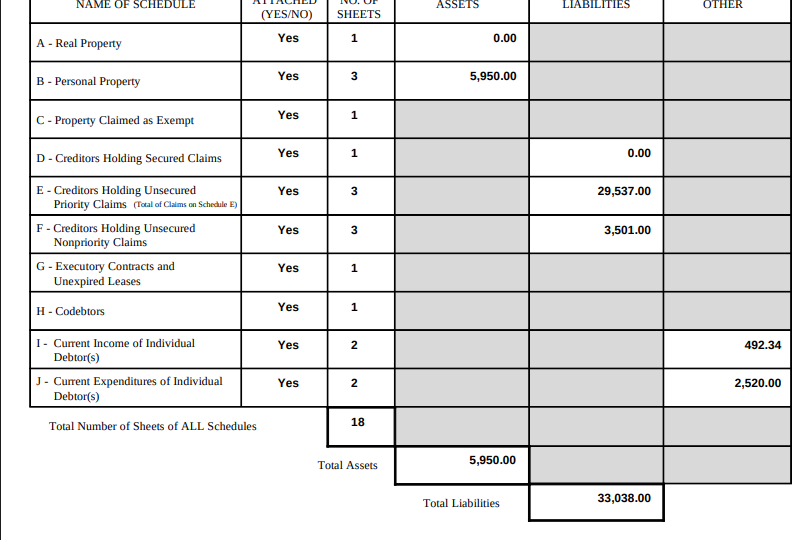
At the time of filing, Buckner listed his total assets at $5,950. His entire worldly possessions, as he declared them under oath, consisted of a checking account at Chase Bank with a zero balance, $1,000 in household goods and electronics, $250 in used clothing, a Ruger Security 6 handgun worth $200, a 2001 Chevrolet S10 pickup with 190,000 miles that had been totaled in a vehicle accident worth $1,000, a 1990 ski boat worth $500, and paragliding equipment — a paraglider, payout winch, harnesses, tandem reserve, helmets, books, and student practice gear — worth $3,000.
He owned no real property. He had no retirement accounts, no stocks, no investments, no receivables, no business interests of any kind disclosed. The man who the BBB lists as owner of Casino Pawn Shop in Van Buren, Arkansas — a business incorporated in 1998 that had been operating for twenty-five years at the time of this filing — listed zero business interests in his bankruptcy schedules.
His total liabilities were $33,038. Of that, $29,537 was listed under a single category: Domestic Support Obligations. Three separate accounts with the Arizona Department of Economic Security Child Support division totaling $25,445, $3,283, and $809 respectively. Nearly ninety percent of everything William Sean Buckner owed at the time of his bankruptcy filing was child support — money owed to his own daughters.
His income at the time of filing: $492.34 per month, derived entirely from self-employment as a paraglider instructor. His annual income for 2014 had been $9,600. For 2013, it had been $7,800. He was fifty-some years old, self-employed as a paraglider instructor, earning less than ten thousand dollars a year, with two daughters and nearly thirty thousand dollars in unpaid child support — and no disclosed business interests of any kind.
His monthly expenses totaled $2,520, against income of $492.34, producing a monthly deficit of $2,027.66. He listed $750 per month in "payments of alimony, maintenance, and support" in his expense schedule — suggesting he was at least nominally acknowledging a child support obligation — but given his documented history of non-payment, whether those payments were actually being made is a separate question entirely.
The bankruptcy petition listed his occupation as "Paraglider Instructor," self-employed, for 2.5 years, operating out of 15715 W. Shiloh, Goodyear, Arizona 85338.
There is a critical legal point here that voters deserve to understand. Child support obligations are generally not dischargeable in bankruptcy. Under federal bankruptcy law, domestic support obligations — including child support — survive a Chapter 7 discharge. They cannot be wiped out. But filing bankruptcy does have the effect of discharging other debts, freeing up whatever limited income the debtor has to theoretically address the non-dischargeable obligations. The question of whether Buckner's bankruptcy actually resulted in more child support being paid to his daughters — or whether it simply cleared his other debts while the child support arrears continued to accumulate — is answered by subsequent court records. It continued to accumulate. By March 2025, a decade after the bankruptcy, the State of Oklahoma entered a judgment against him for $15,383.62 in unpaid child support covering the period from January 2016 through February 2025.
The $46,000 Arizona Civil Judgment: A Business That Sued Him
While the divorce was consuming the Maricopa County family court, a separate civil case was working its way through the same courthouse. Case number CV2009-020756, filed June 26, 2009, J & H Systems LLC versus William Buckner.
A company called J & H Systems LLC sued Buckner. He didn't respond. The plaintiff had to go through an elaborate process of service by publication — meaning they couldn't even find him to serve him with papers — before eventually obtaining a default judgment against him in May 2010.
The judgment: $46,189.81 in principal, plus $300 in attorney fees, plus $472.40 in costs. Total: $46,962.21. The judgment was significant enough that the plaintiff filed an Affidavit of Renewal of Judgment in 2015 — meaning five years after the original judgment, it still hadn't been paid, so they had to formally renew it to keep it legally enforceable.
So in 2015, the same year Buckner filed for bankruptcy listing nearly $30,000 in unpaid child support, a separate Arizona civil court still had an active, renewed judgment against him for nearly $47,000 owed to a business. The bankruptcy filing does not appear to list J & H Systems LLC among his creditors — raising its own questions about whether the disclosure was complete.
The Federal Lawsuit Found Frivolous: $50,000 More
The pattern continued in Oklahoma. After relocating to Sallisaw in Sequoyah County, Buckner found a new arena for legal combat. In 2022, he filed a federal civil rights lawsuit against the City of Sallisaw, Police Lieutenant Houston Murray, and Police Chief Terry Franklin — Case No. CIV-22-146-JAR in the Eastern District of Oklahoma.
The lawsuit arose from a traffic stop. Buckner transformed that traffic stop into a federal civil rights case, alleging constitutional violations against the local police department and its leadership.
On April 29, 2024, U.S. District Judge Jason A. Robertson granted summary judgment in favor of the defendants, against Buckner. The court found the lawsuit frivolous, unreasonable, and groundless. On May 2, 2025, the court entered an Order Taxing Costs — awarding the defendants $956.19 in transcript and copying costs to be added to the judgment against Buckner. This was on top of the approximately $50,000 in attorney's fees that prior reporting from the Sequoyah County Times and Eastern Times Register confirmed had already been ordered against him. Buckner appealed, retained an attorney who turned out to be ineligible to practice before the Tenth Circuit, and ultimately abandoned the appeal. The case was dismissed with prejudice. He owes the money.
New Jersey, August 2024: Criminal Trespass and Threatening Language
While all of this was unresolved — the child support judgment accumulating in Oklahoma, the frivolous lawsuit fee judgment in federal court, the decades-long history of non-payment documented in Arizona — Sean Buckner traveled roughly 1,400 miles from Sallisaw, Oklahoma to Jersey City, New Jersey.
On August 6, 2024, according to New Jersey Municipal Court records case SF 2024 453455, Buckner was charged with criminal trespass under N.J.S.A. 2C:18-3B — specifically defiant trespass, meaning he entered or remained somewhere after being told not to — and with violating municipal ordinance 242-11A: no person shall engage in loud, boisterous, or threatening language.
The case originated in Jersey City Municipal Court before being transferred to Kearny Municipal Court. After more than a year of litigation with two defense attorneys — Jonathan F. Marshall, Esq. and Matthew J. Dorry — the disposition came on November 26, 2025. The finding: Guilty.
The assessed fine was $533. A payment plan was established starting December 4, 2025, requiring payments every 30 days, with a final payment due date of January 3, 2026. As of the most recently available records, the amount paid is $0.00. The status is Delinquent.
What was Sean Buckner doing in Jersey City in August 2024? The court record does not say. What it does say is that he was found guilty of knowingly entering a place after being told not to and of using threatening language while doing so. The same behavioral pattern documented in his Oklahoma federal lawsuit — refusing to be told he is not welcome somewhere, escalating encounters rather than de-escalating them — manifested in a completely different state, 1,400 miles away, and resulted in a criminal conviction.
The Pawn Shop Nobody Was Supposed to Know About
Running through all of this — the Arizona divorce, the child support non-payment, the bankruptcy, the civil judgments, the Oklahoma federal lawsuit, the New Jersey criminal conviction — is a thread that ties it all together: a pawn shop in Van Buren, Arkansas that Sean Buckner apparently did not want anyone to know he owned.
Casino Pawn Shop at 2120 Alma Highway in Van Buren, Arkansas has been in business since 1990, incorporated since 1998. According to the Better Business Bureau's accredited listing — BBB-accredited as recently as September 26, 2025 — Mr. Sean Buckner is listed as owner across every category: Business Management, Principal Contacts, and Customer Contacts. The business also holds a Federal Firearms License from the Bureau of Alcohol, Tobacco, Firearms and Explosives, number 5-71-033-02-2D-36527, making it a federally licensed firearms dealer. A related business, Midland Pawn & Jewelry Inc., is also listed.
But there is a second BBB listing for the same business — Casino Pawn Shop, Inc. — at the same address, which lists no mention of Sean Buckner at all. That filing lists John Lewellen as President and Randy Faldon as Manager.
Now look at the 2015 bankruptcy petition. Buckner listed zero business interests. He disclosed no ownership of any corporation, partnership, or business entity. He listed no income from Casino Pawn Shop. He listed no stock, no equity interests, no business assets of any kind. He was a paraglider instructor making $492 a month. That is what he swore to under penalty of perjury in federal court.
Yet Casino Pawn Shop was incorporated in 1998 — seven years before the bankruptcy. If Buckner was the true owner of that business in 2015, and he failed to disclose it in his federal bankruptcy petition, that would constitute a serious issue: concealing assets in a bankruptcy proceeding carries penalties of up to a $500,000 fine or five years imprisonment, as the bankruptcy petition itself warns on its final page.
An anonymous tipster recorded through a formal platform put the situation bluntly: ownership of the pawn shop is kept "hush-hush" to avoid issues with child support, and the rumor is that the business is held through his wife's name. His own words on Facebook — "I won a pawn shop" — casually confirm he considers himself its owner. The BBB's accredited listing confirms his name is on file as owner. But in federal court, under penalty of perjury, he disclosed no business interests whatsoever.
The Senate Candidacy: The Full Picture
William Sean Buckner filed to run for the United States Senate seat representing Oklahoma in the 2026 election, challenging Republican frontrunner Rep. Kevin Hern for the seat vacated by Markwayne Mullin's appointment as U.S. Secretary of Homeland Security.
The complete documented record of his financial and legal history now spans four states and three decades:
In Arizona: A 14-year family court battle over child support and custody, including at least three formal contempt petitions for non-payment of support, court-appointed accountants to verify his income because it was impossible to determine otherwise, multiple income withholding orders, and sustained intervention by the Arizona Department of Economic Security on behalf of his daughters.
In Arizona: A Chapter 7 bankruptcy in 2015 listing nearly $30,000 in unpaid child support as his primary liability, while disclosing zero business interests despite evidence suggesting he had an ownership stake in a pawn shop operating in Arkansas.
In Arizona: A civil judgment of $46,962.21 entered against him by J & H Systems LLC in 2010 after he failed to respond to a lawsuit, still unpaid enough five years later that the creditor had to renew the judgment.
In Oklahoma: A federal civil rights lawsuit arising from a traffic stop that a federal judge found frivolous, unreasonable, and groundless, resulting in approximately $50,000 in attorney fees awarded against him plus an additional $956.19 in taxed costs.
In Oklahoma: A formal State of Oklahoma court judgment for $15,383.62 in unpaid child support entered in March 2025 by Oklahoma Human Services Child Support Services in Sequoyah County, covering the period from January 2016 through February 2025.
In New Jersey: A criminal conviction in Jersey City Municipal Court for defiant trespass and boisterous, threatening language, resulting in a $533 fine that remains entirely unpaid with delinquent status.
In Arkansas: An ownership interest in a federally licensed pawn and firearms dealership that sources say was deliberately kept obscured from public view to avoid complications with child support enforcement.
When he filed for bankruptcy in 2015, Buckner declared his monthly income at $492.33 — less than what most Americans spend on groceries. He listed himself as a paraglider instructor. He was a man whose ex-wife and the state of Arizona were simultaneously pursuing him in court for non-payment of child support for the daughters he had fathered.
Yet somewhere in that same period, or shortly thereafter, Casino Pawn Shop in Van Buren, Arkansas was operating under his name — a cash-heavy firearms dealership with a federal license, multiple business entities, and a related jewelry operation. The gap between the man he presented to the federal bankruptcy court and the man who appears on the BBB's accredited business listing is one that demands explanation.
What This Means for Oklahoma Voters
A United States Senator casts votes on federal appropriations, including the Title IV-D funds that finance state child support enforcement programs — the very programs that spent years chasing Buckner for the support his daughters were owed. A United States Senator oversees federal agencies including the Bureau of Alcohol, Tobacco, Firearms and Explosives — the agency that issued the federal firearms license to the pawn shop he owns. A United States Senator is entrusted with confirming federal judges — the same federal judiciary that found his lawsuit frivolous and ordered him to pay $50,000 in sanctions.
The question for Oklahoma voters is not whether Sean Buckner has had a difficult life, or whether his grievances with local police or his ex-wife's lawyers were in some respects justified. People have complicated lives. Courts don't always get things right. Divorces are painful. The question is whether the pattern documented across three decades and four states — a consistent, documented, multi-jurisdictional pattern of failing to meet financial obligations to children, businesses, courts, and states — reflects the character of a man fit to hold one of the most powerful elected offices in the American government.
His daughters grew up while their father fought everyone but his obligation to them. The state of Arizona spent fourteen years intervening on their behalf. The state of Oklahoma had to enter a formal court judgment to document what he owed. A business he owed nearly $47,000 had to serve him by publication because they couldn't find him. A federal court called his lawsuit against local police frivolous. A New Jersey court found him guilty of trespass and threatening language. And through all of it, the pawn shop whose existence was kept hush-hush kept its doors open in Van Buren, Arkansas.
He named his Facebook page "Transparency."
The documents suggest a different word applies.
This report is based on Maricopa County Superior Court family court records (case FC2004-071006), Maricopa County Superior Court civil records (case CV2009-020756), United States Bankruptcy Court District of Arizona records (case 2:15-bk-02377-DPC), United States District Court Eastern District of Oklahoma records (case CIV-22-146-JAR), State of Oklahoma Sequoyah County child support judgment documents, New Jersey Municipal Court records (case SF 2024 453455), Better Business Bureau records, Federal Firearms License records, Sequoyah County Times and Eastern Times Register reporting, anonymous tip transcripts, and Oklahoma candidate filing records. Sean Buckner has not been contacted for comment prior to this draft. Any subject of investigative reporting is entitled to respond to the record, and any response would be incorporated in a final published version.
