BOMBSHELL: Sean Buckner Admits Senate Run Was For “Ulterior Motives”
A tip submitted to PublicCrime.com includes a message apparently sent by Sean Buckner himself admitting that his Oklahoma Senate campaign was never a genuine bid for office — raising explosive questions about what he has actually been doing with his followers' trust, time, and money
From the moment Sean Buckner filed his Declaration of Candidacy for the United States Senate seat in Oklahoma he has presented his campaign as a genuine and serious effort to win that seat and represent the people of Oklahoma in Washington.
He has asked his followers to share his content. He has asked them to believe in the mission. He has asked them to trust that he is fighting for them in a race he intends to win. He has built a platform called auditthesenate.com that implies a sitting Senator who intends to audit the institution from the inside.
A tip submitted to the PublicCrime.com tip form suggests all of that has been a performance.
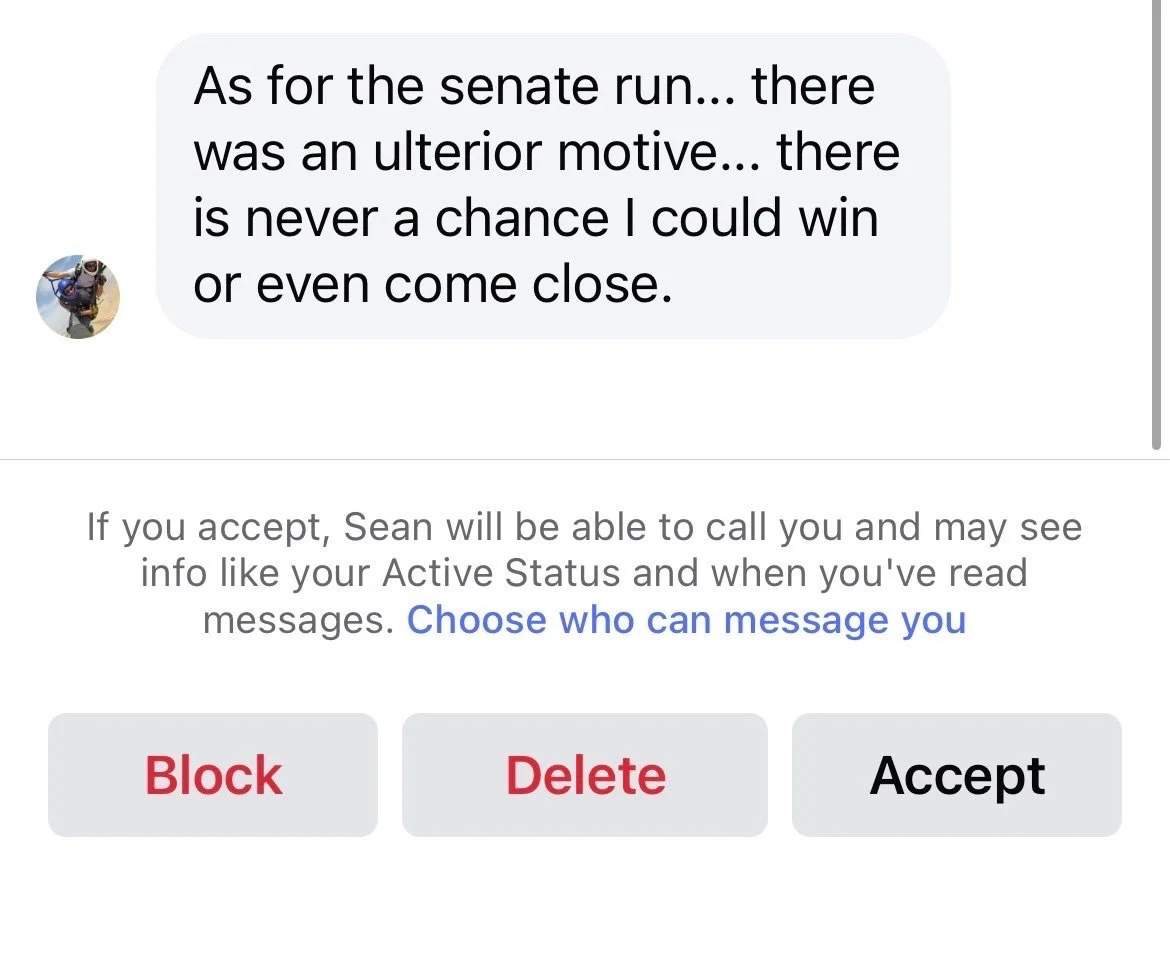
The tip includes what the source describes as a message sent by Sean Buckner himself to another individual. The message reads as follows.
As for the Senate run. There was an ulterior motive. There is never a chance I could win. Or even come close.
Those are his words. Not this publication's characterization of his words. Not an interpretation or a paraphrase. His words as reportedly written by him in a private message.
There was an ulterior motive.
There is never a chance I could win.
Or even come close.
What This Admission Means
Let us take each element of that statement in turn because each one is significant on its own and devastating in combination.
There was an ulterior motive.
An ulterior motive is by definition a hidden reason. A purpose that is not the stated purpose. A goal that is different from the goal being publicly presented. Sean Buckner has been publicly presenting his Senate campaign as a genuine effort to win a seat and represent Oklahoma. His own private message says the actual motive for running was something else entirely.
What is that ulterior motive? The message as provided to this publication does not specify. But the question of what someone running for Senate without any intention of winning is actually trying to accomplish is one of the most important questions Oklahoma voters and the broader public deserve to have answered.
Is it platform building? Running for Senate — even without winning — generates significant media attention, social media growth, name recognition, and follower acquisition. A man who had built a substantial First Amendment auditing following could dramatically expand that following through a Senate run. More followers means more video views. More video views means more monetization. More monetization means more revenue from a media and content operation.
Is it fundraising? Senate campaigns can legally raise significant amounts of money. Campaign finance laws do permit certain uses of campaign funds that benefit the candidate's political operation and profile even in a losing race. A man who privately knew he could never win but publicly ran as if he could would have access to donor money that would not have been available to him as a simple First Amendment auditor.
Is it serving a third party's interests? This investigation has previously raised the question of whether Sean Buckner's candidacy has been cultivated and supported by individuals who benefit from his presence in the race without requiring a victory. A candidate in a Senate primary can serve numerous purposes for backers without ever winning — from splitting votes in ways that benefit another candidate to generating specific kinds of political attention to issues that serve the backers' interests.
Is it the media operation? This investigation has previously noted the connection between Buckner and Ron Durbin through Guerrilla Publishing and related media activities. A Senate candidacy provides extraordinary content for a media operation built around political confrontation and First Amendment advocacy. Win or lose — and Buckner apparently knew it would be lose — the candidacy generates material.
We do not know which of these explanations accounts for the ulterior motive Buckner reportedly described. We know he said there was one. That admission demands an explanation he has not provided.
There is never a chance I could win. Or even come close.
This is the part of the message that should matter most to the people who have followed Sean Buckner, shared his content, donated to his campaign, and believed in his candidacy.
He knew. Before he filed. Before he built the website. Before he started the Facebook page. Before he asked people to trust him. Before he put his name on a ballot. He knew he could never win. He knew he would not even come close.
And he ran anyway.
He asked for his followers' loyalty knowing the campaign was not what he was presenting it as. He asked for their shares and their donations and their enthusiasm knowing the race was not a genuine contest he intended to win. He performed a Senate candidacy for an audience that believed it was real while privately acknowledging to at least one other person that it was not.
That is not politics. That is not even spin. That is a deliberate deception of the people who trusted him most.
The Pattern This Fits
This admission — if the message is authentic — does not come as a surprise to anyone who has read this investigation in its entirety. It fits a pattern that the public record has been revealing for weeks.
From the beginning of this investigation the question of why Sean Buckner is running for Senate has been one of the most difficult to answer through conventional public records research. The documented financial picture of a man with unpaid child support, a discharged bankruptcy, fifty thousand dollars in unpaid legal fee sanctions from a frivolous lawsuit, and a New Jersey criminal conviction is not the picture of a man who spontaneously decides to mount a credible Senate campaign.
Senate campaigns cost money. Infrastructure costs money. Digital operations cost money. Travel costs money. Filing fees cost money. A man whose documented financial history is as troubled as Buckner's does not fund all of that from personal resources without an explanation for where the money is coming from.
This investigation has previously raised the question of whether Buckner has financial backing from individuals whose interests are served by his presence in the race even without a victory. The reported admission of an ulterior motive is consistent with that theory.
This investigation has previously raised the question of whether the Senate candidacy is primarily a platform-building exercise designed to expand his media and content operation rather than a genuine bid for office. The reported admission that he knew he could never win or come close is consistent with that theory.
This investigation has previously raised the question of whether Sean Buckner's public persona — the plain-spoken constitutional warrior fighting for ordinary Oklahomans — is a carefully constructed performance rather than an authentic identity. The reported private admission of a hidden purpose behind the public campaign is consistent with that theory.
Every thread this investigation has pulled has led to the same place. A gap between what Sean Buckner says publicly and what the evidence suggests is actually happening. A gap between the story he tells and the story the documents show. A gap between the character he performs on camera and the character that emerges from court records, business filings, forum posts, and now a private message that reportedly says in his own words what this investigation has been suggesting for two weeks.
The Followers Who Deserve to Know
Sean Buckner has built a following of people who genuinely believe in what he told them he was doing. People who have watched his First Amendment auditing videos and believed he was fighting for their rights. People who have shared his Senate campaign content because they believed he was a real candidate fighting for real change. People who have donated money — however small the amounts — because they believed they were contributing to a genuine political effort.
Those people deserve to know what this tip suggests.
They deserve to know that the man they trusted apparently knew all along that the Senate race was not what he was telling them it was. That there was an ulterior motive he has not disclosed. That he never believed he could win or even come close.
If the message is authentic — and this publication is continuing to verify its authenticity through all available means — it represents one of the most direct and specific betrayals of follower trust this investigation has documented. And this investigation has documented many.
He took their loyalty. He took their shares. He took their donations. He took their time and their enthusiasm and their belief that someone was finally fighting for them.
And apparently he knew from the beginning that the fight he was performing was not the fight he was actually engaged in.
The Questions That Now Demand Answers
Sean Buckner owes his followers and the public specific answers to specific questions that this message raises.
What is the ulterior motive you referenced in your private message? If the Senate run was not about winning what was it actually about?
Who else knew about the ulterior motive? Did your financial backers, your advisors, and the people supporting your campaign know that you privately believed you could never win?
Did you solicit donations from supporters while privately knowing the campaign was not a genuine bid for office? What did you tell donors about the purpose and prospects of your campaign?
Is the ulterior motive connected to your media and content operation? To the interests of financial backers? To Ron Durbin or others in your network? To some other purpose you have not disclosed?
What do you owe the followers who trusted you with their loyalty and their donations based on the public presentation of a genuine Senate campaign?
These questions deserve direct and complete answers. Not Facebook posts threatening journalists. Not claims that the reporting is false. Not performances of outrage designed to redirect his followers' attention from what he actually said.
Answers. Specific. Direct. Under his own name.
He has not provided them. He may not provide them. But the record of whether he was asked and whether he answered will stand regardless.
A Note on Verification
This publication received this tip through our public tip submission form. We are treating it with the seriousness it deserves and the caution that responsible journalism requires.
We have not been able to independently verify the authenticity of the message through means available to a citizen journalism operation of our size and resources. We are reporting its existence and content because the tip was submitted through our formal channel, because its content is consistent with every pattern this investigation has documented across weeks of public records research, and because the public interest in its contents — if authentic — is significant enough to warrant reporting with appropriate caveats about verification status.
We are continuing to pursue verification through every available channel. If evidence emerges that the message is not authentic we will correct the record immediately and prominently. If additional evidence confirms its authenticity we will report that as well.
We are also formally requesting that Sean Buckner address this message directly and publicly. If the message is not authentic he should say so specifically — not with a general denial of the investigation's findings but with a specific denial of this specific message and an explanation of how it came to be submitted to our tip form.
His response or non-response will itself be informative.
What This Means for Oklahoma Voters
Oklahoma Republicans vote in their Senate primary on June 16, 2026. They are making a decision about which candidate to support in a race that will determine who represents their state in the United States Senate.
They are entitled to know that a candidate in that race has reportedly admitted in a private message that his campaign has an ulterior motive and that he never believed he could win or even come close.
They are entitled to ask what that ulterior motive is, who benefits from it, and what it says about the character and honesty of the man asking for their vote.
They are entitled to consider whether a man who privately admits his campaign is not what he is publicly presenting it as is someone they want representing their values, their interests, and their state in any capacity.
And they are entitled to consider this admission alongside everything else this investigation has documented. The undisclosed business entities. The Chinese company representative role. The unpaid child support. The New Jersey criminal conviction. The frivolous federal lawsuit. The protective order filed against him in Tulsa County. The dressage photography history that contradicts his plain-spoken working man narrative. The military claims that remain unverified. The threats against this journalist. The email that served both a Chinese manufacturer and a Senate candidacy.
All of it together. The complete picture.
A man who privately admits his Senate run has an ulterior motive and that he could never win has told you something important about who he is and what he is doing.
The question is whether Oklahoma voters are listening.
A Direct Message to Sean Buckner's Followers
We want to speak directly to the people who have followed Sean Buckner through his First Amendment auditing years and into his Senate campaign.
We know many of you are genuinely frustrated with government. We know many of you have real and legitimate grievances about how institutions treat ordinary citizens. We know many of you believed in what Sean Buckner said he was doing and trusted him with your loyalty because of that belief.
We are not your enemy. This investigation is not an attack on you or your values. It is an attempt to give you the information you deserve about the person you have been trusting.
If this message is authentic — if Sean Buckner privately admitted that his Senate run had an ulterior motive and that he never believed he could win — then the people most betrayed by that admission are not his political opponents. They are you. The followers who believed in him. The people who shared his content and donated to his campaign and told their friends and family that Sean Buckner was the real deal.
You deserved honesty. The public record and now this tip suggest you did not get it.
You deserve better than a candidate who performs a Senate race for reasons he has not disclosed while asking for your trust and your money.
Oklahoma deserves better.
And the cause of genuine accountability in government — which many of you actually believe in — deserves better than being used as a vehicle for whatever ulterior motive Sean Buckner has privately admitted to pursuing.
This article is based on a tip submitted to the PublicCrime.com tip form. The message quoted in this article has not been independently verified through means currently available to this publication. It is being reported with that caveat clearly stated because its content is significant, its source submitted it through our formal tip channel, and the public interest in its contents is substantial. PublicCrime.com is continuing verification efforts and will update this reporting as additional information becomes available. Sean Buckner was given the opportunity to respond to the specific claims in this article prior to publication. As of publication time no response has been received. Any response will be published promptly and in full.
Dustin Terry is a blogger, citizen journalist, Air Force veteran, and former cyber intelligence analyst contributing to PublicCrime.com.